Free Plumbing Estimate Template (Excel, Google Sheets, PDF)
Keep your plumbing job paperwork clear. Customize the scope, line items and business details, then share a professional estimate with your customer.
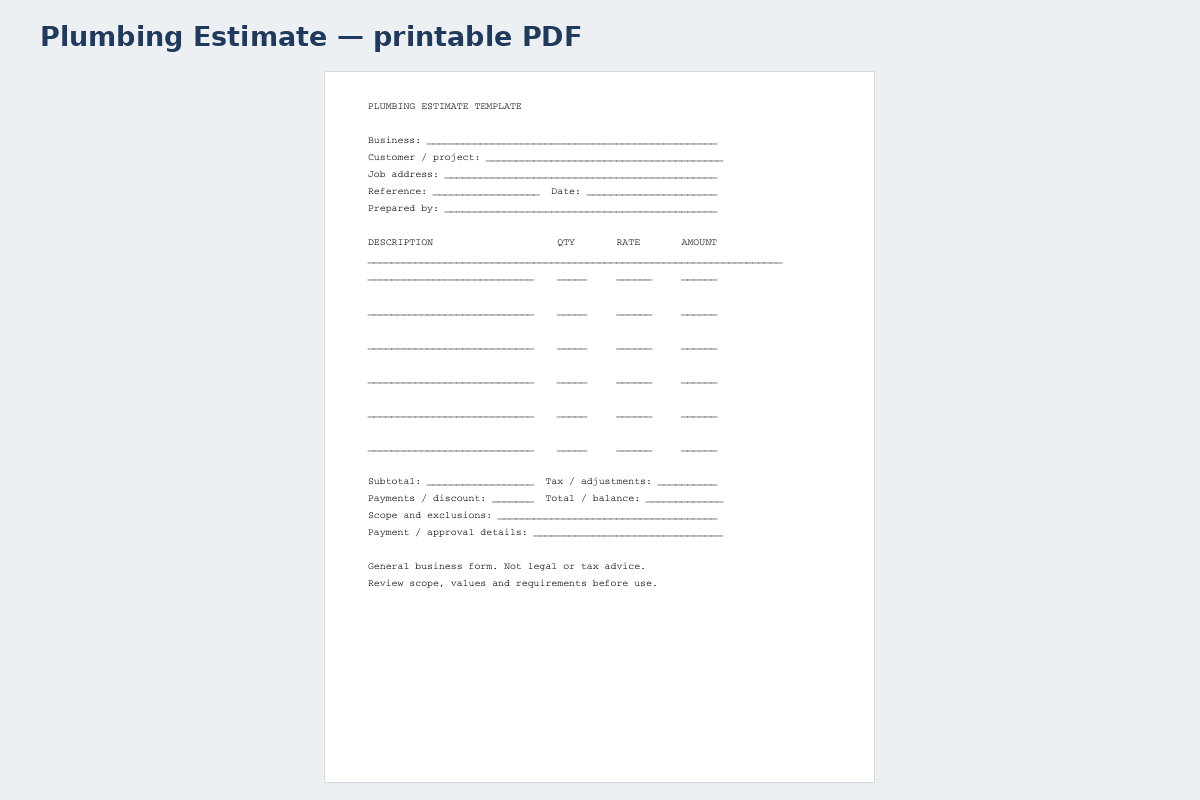
Printable PDF template · Plumbing Estimate↗ Open full size (new tab)
Download your plumbing estimate template
No signup needed. Excel 2016 or later. For Google Sheets, import the Excel file with File → Import → Upload.
Get the details right
What to include
Describe fixtures, pipe work, access and the repair area. State assumptions about concealed damage, permits and restoration.
- Your business and customer details
- Job address and document number
- Clear scope, quantities and line-item amounts
- Taxes, adjustments and total where applicable
- Payment or approval details and exclusions
Separate plumbing access, rough-in and finish work
Describe the symptom or proposed installation and identify the fixtures or pipe runs affected. A leaking fitting, a bathroom rough-in and a full fixture replacement have different access and testing requirements. State which walls, floors or cabinets must be opened and whether making good those surfaces is included. If concealed pipe condition is unknown, explain the inspection assumption and approval process for additional work.
Split fixtures, valves, fittings, pipe materials and labor into understandable groups. For rough-in work, describe the connections and preparation included before fixtures are installed. For finish work, identify the installation and checks associated with the selected fixtures. Record who supplies each item and whether a fixture allowance is a budget placeholder rather than a confirmed product price.
Show permit or inspection arrangements where applicable, but confirm local requirements before promising an amount or outcome. If an emergency attendance fee, after-hours uplift or diagnostic visit is part of this quote, state it openly and explain what it covers. Finish with exclusions such as remediation, concealed damage or restoration so the customer knows which activities require a separate decision.
How to fill it in
- Describe the plumbing scope
Record the service address, affected fixtures and whether the work is diagnostic, rough-in, replacement or finishing.
- Identify access and supplied items
List opening-up work, customer-supplied fixtures and restoration exclusions before calculating labor.
- Build the material and labor allowance
Separate fixtures, fittings, pipe work, testing and any applicable permit arrangements using your own costs.
- Confirm the proposal with the customer
State the quote assumptions, approval process for concealed problems and payment terms before scheduling.
A worked example
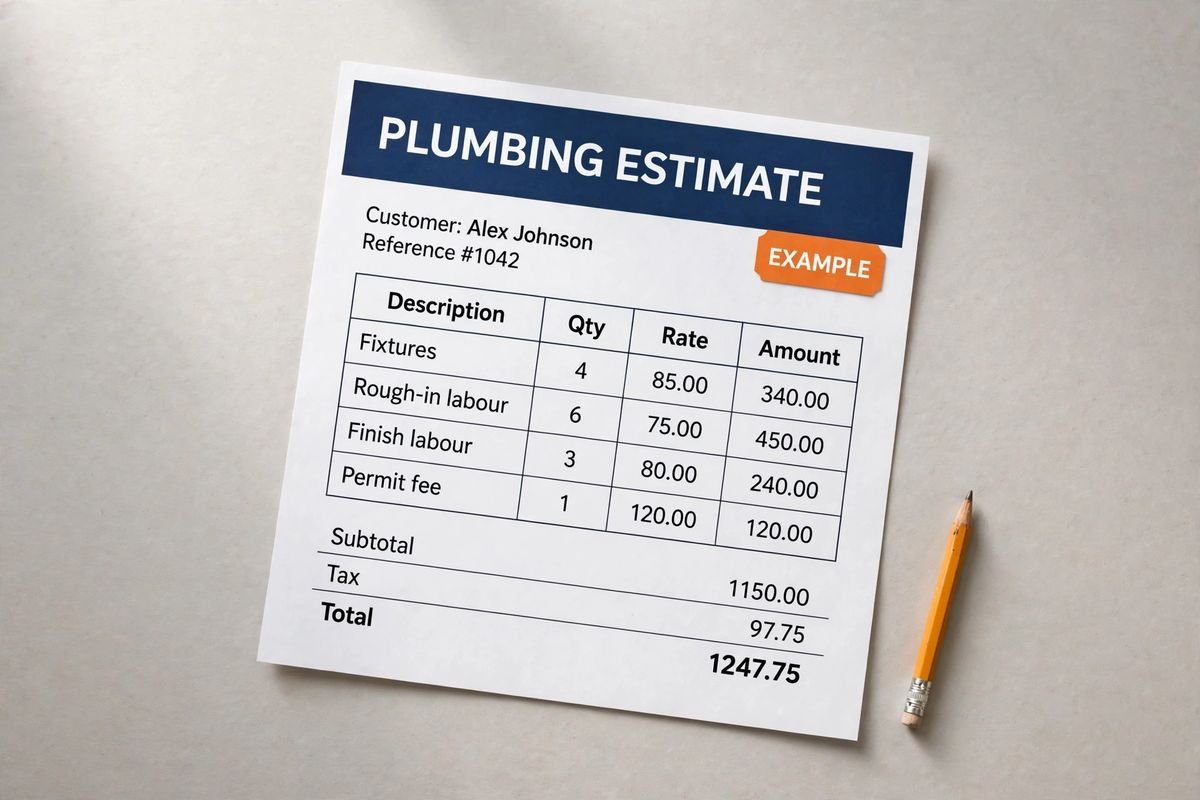
| Cost or work item | Amount |
|---|---|
| Replacement fixture | $240.00 |
| Fittings and supply materials | $85.00 |
| Plumbing labor | $380.00 |
| Cleanup and disposal | $55.00 |
| Direct costs | $760.00 |
Example only. These are not published market rates or a suggested price.
Keep the calculation clear
Verify every formula after adding rows or changing the worksheet. A markup rate is not the same as a profit margin. Your local tax, permit and contract requirements may differ.
Ready to use it?
No signup needed. Excel 2016 or later. For Google Sheets, import the Excel file with File → Import → Upload.
Plumbing estimate guide
How to write a plumbing estimate customers sign
Short answer: a plumbing estimate is a written, line-by-line price for a plumbing job — the fixture or pipework, fittings, labour, testing and cleanup — with a total, a deposit and a validity date. The free template above comes in Excel, Word and PDF; or build the same estimate on your phone in the free estimate maker, with typical plumbing lines already filled in.
Completing the worked example: tax, total, deposit and balance
The example above stops at direct costs. Here is the same job taken through to the figure the customer actually pays — a bathroom faucet and supply-line replacement for a homeowner in Austin, Texas, valid for 30 days.
| Cost or work item | Amount |
|---|---|
| Replacement fixture (chrome two-handle faucet, as selected) | $240.00 |
| Fittings and supply materials | $85.00 |
| Plumbing labour | $380.00 |
| Cleanup and disposal | $55.00 |
| Direct costs (subtotal) | $760.00 |
| Sales tax — 8.25% on materials only ($325.00) | $26.81 |
| Total | $786.81 |
| Deposit due on acceptance (10%) | $78.68 |
| Balance due on completion | $708.13 |
Two choices here are worth copying. Tax is charged on the $325.00 of materials only, not on the labour or cleanup — in Texas, residential repair labour is not taxable and, on a separated estimate like this one, the materials are. That only works because the fixture and fittings are on their own lines instead of one “plumbing” figure. And the fixture is priced as a named product: a faucet the customer has chosen is a fixed price, while an allowance is only a budget until they choose (see below). Example figures only — not market rates or a suggested price. Sales-tax rules differ by state; check yours.
Fixtures, allowances and who supplies what
Most plumbing disputes start with a fixture, not with labour. Write the fixture down by name, model and finish, and state who supplies it. If you supply it, its price is fixed for that product. If the customer supplies it, say so and price only the labour, fittings and testing — and say who pays for the return trip if their fixture arrives damaged, incomplete or the wrong size.
An allowance is not a price, and the estimate must label it as one: “Faucet allowance up to $240.00, product to be chosen.” The customer pays the difference if they pick a $400 faucet and gets a credit if they pick a $150 one. Written as a plain price, the customer remembers the number and forgets the word “allowance”. The same goes for rough-in work: state the pipe material (copper, PEX or PVC), the number of fixture connections included, and what happens if the count changes.
Split the price the way the job is built — fixtures, fittings and pipe on their own lines, rough-in and finish labour separately, testing on its own line. A customer comparing two estimates can then see whether the cheaper one is cheaper on labour, or because it left out the fittings, the testing or the cleanup.
Trip, diagnostic and emergency call-out fees
Many plumbing jobs start with a visit, and the visit has a price. State it openly: a trip or diagnostic fee for attending, finding the fault and quoting the repair; any after-hours uplift; and whether the diagnostic fee is credited against the repair if the customer goes ahead. Put it on its own line, not folded into labour.
Say what the fee covers. A diagnostic visit covers finding the fault and quoting it — not opening a wall, replacing a part or fixing a second fault found on the way. If opening up is needed to diagnose the problem, that is a separate decision with its own price and approval, agreed before the wall comes open. Use your real fee, disclose it before you attend, and keep it the same for every customer in the same area and hours.
Permits, inspections and testing
Some plumbing work needs a permit and inspection and some does not — it depends on the job and your local authority. A like-for-like faucet swap, as in the example, usually needs neither; a new bathroom rough-in, a water-heater replacement, a sewer-line replacement or anything that moves a drain or vent usually needs both. State whether a permit is included, who applies for it, and whether the fee is fixed or passed through at cost.
Testing is part of the job, not an extra. A pressure test after a supply-line replacement, a leak check on every joint you touched and a drain test after a waste-pipe repair are the proof the work holds — list the test on its own line and record the result on the job sheet. Do not promise an inspection date or outcome: state that the work will be left ready for inspection and that a re-inspection fee caused by a failed item is charged separately. This is general information, not legal or licensed-trade advice.
Markup is not margin — check it on every job
A 20% markup is not a 20% margin. Add 20% to the $760.00 of direct costs and the price is $912.00 — but the $152.00 profit is 16.7% of the price, not 20%. On a $7,600 job, pricing at a 20% markup ($9,120.00) instead of a true 20% margin ($9,500.00) leaves $380.00 on the table. Work from the margin you need, then find the markup that gives it: a 25% margin needs a 33.3% markup, and a 30% margin needs 42.9%. In the estimate maker, enter your cost on each line and the private “Your margin” panel shows your real markup and margin — your costs are never printed on the customer’s copy.
Deposits and the law
Deposit limits are set by state law, not custom. California caps a home-improvement deposit at $1,000 or 10% of the contract price, whichever is less (Business and Professions Code § 7159.5). Maryland’s current law caps it at one-third of the contract price (Business Regulation § 8-617), and Massachusetts at one-third, or the cost of special-order materials if that is higher (M.G.L. c. 142A). The example’s 10% deposit ($78.68 on $786.81) sits inside all three; a 50% deposit on the same job would not. Rules change and other states differ — check your own state’s current rules before you send the estimate. This is general information, not legal advice.
Before you send it: a quick checklist
- Fixtures named, with who supplies each — and every allowance labelled as an allowance.
- Trip, diagnostic and permit fees on their own lines, if they apply.
- Exclusions written down: remediation, concealed pipe damage, restoring opened walls or floors — and a line saying concealed work is priced and approved by change order before it starts.
- Tax on materials only where that is your state’s rule; total, deposit and balance checked.
- A 30-day validity date, payment terms and a signature block.
Common mistakes on plumbing estimates
- One lump-sum “plumbing” line. It hides the fixture price and the tax base, and cannot be compared line by line.
- An allowance written as a price. The upgrade then becomes a dispute.
- No access or making-good line. Opening a wall and closing it again are two jobs; if restoration is not included, say so before the wall is opened.
- No testing line. No proof the work holds — and no record if it leaks a week later.
- Tax on labour in a state where only materials are taxable.
- No validity date, so you end up honouring an old price for months.
Plumbing estimate vs quote vs invoice
An estimate is your best price for a defined scope, valid for a set time, and it can change if hidden work appears. A quote is a firmer fixed price, usually for a smaller job where nothing hidden is expected. An invoice is the bill after the work, or for a deposit, and should match the estimate’s lines. Send the estimate, get it signed, then invoice from it — and if concealed damage turns up once a wall is open, write a change order and get that signed too. When the job is done, the plumbing invoice template or the invoice generator bills the balance from the same lines.
More plumbing estimate questions
What should a plumbing estimate include?
Your business and licence details, the customer and job address, the scope (access, rough-in, finish, testing, cleanup), line items with fixtures, fittings and labour separated, the tax line, total, deposit and balance, exclusions, a validity date and a signature block.
How long should a plumbing estimate stay valid?
Thirty days is common. Fixture and material prices move, so a longer validity can leave you honouring a price your supplier no longer offers.
Is a plumbing estimate legally binding?
Usually not on its own. It generally becomes binding once the customer signs and you accept it — which is why the signature block matters. The signed estimate plus any signed change orders form the agreement. Contract rules vary by state.
What is the difference between an estimate, a quote and an invoice?
An estimate is a priced scope that can change if hidden work appears; a quote is a firmer fixed price; an invoice is the bill sent after the work or for a deposit.
Should I charge sales tax on plumbing labour?
It depends on the state. Many states tax materials but not labour on residential repairs. In Texas, a separated estimate taxes the materials only — which is why the example charges 8.25% on $325.00 and not on the labour.