Free Roofing Invoice Template (Excel, Google Sheets, PDF)
Bill your roofing work clearly. Itemize completed work, record payments and show the remaining balance with an editable invoice.
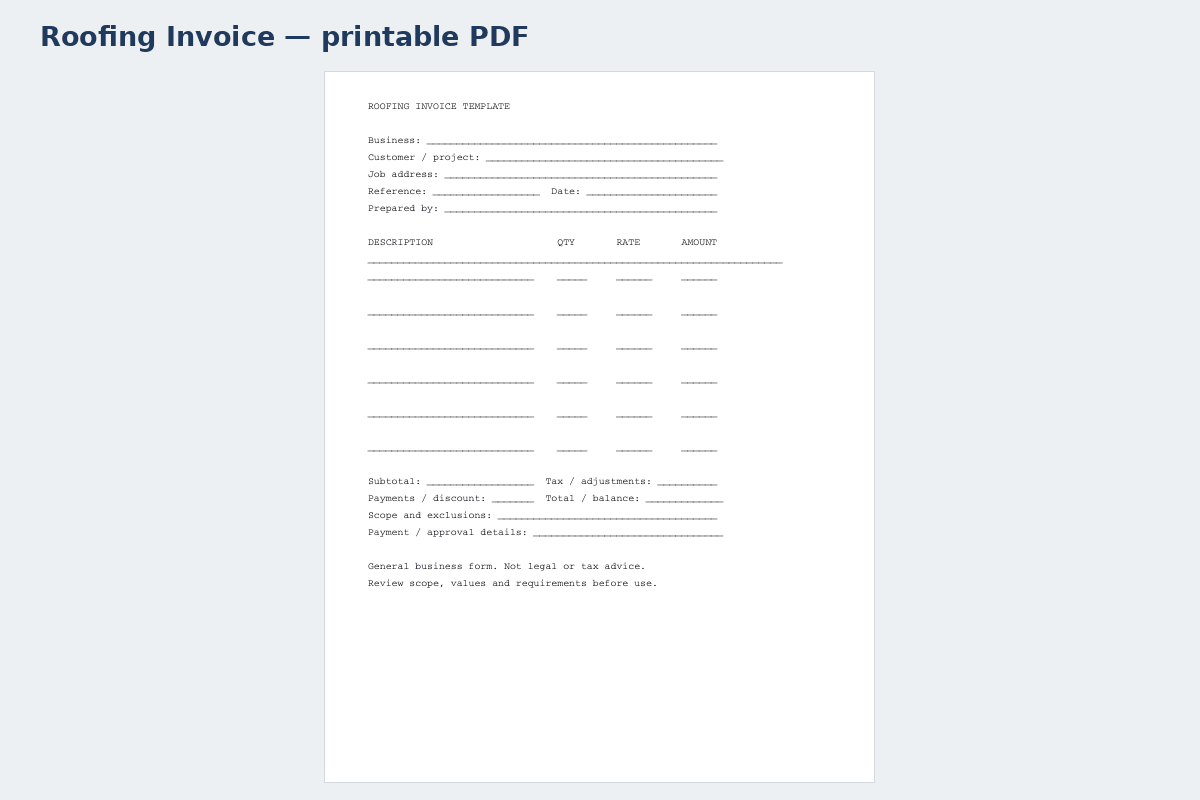
Printable PDF template · Roofing Invoice↗ Open full size (new tab)
Download your roofing invoice template
No signup needed. Excel 2016 or later. For Google Sheets, import the Excel file with File → Import → Upload.
Get the details right
What to include
Measure roof area, pitch, layers and access before pricing. Separate tear-off, materials, flashing, installation and cleanup.
- Business and customer billing details
- Invoice number, issue date and due date
- Completed work, quantities and rates
- Taxes, discounts and prior payments
- Balance due and your payment instructions
Bill the roof work that was actually completed
A roofing invoice closes out an agreed scope; it should not read like a fresh sales estimate. Identify the property, original estimate reference and completed work period. Use recognizable descriptions for the installed roof covering and associated repairs. If the job was billed in stages, name the milestone or completed portion instead of making every invoice appear to charge for the whole roof.
Separate the original contract work from approved additions such as extra deck replacement or an additional tear-off layer. Include each variation's reference and the customer's recorded approval. Do not convert an unapproved allowance into an unexplained charge. If disposal, flashing or ventilation was already included in the base amount, check that it has not also been billed as an extra.
Show the gross amount, applicable adjustments and payments already received before calculating the balance. Attach or reference completion photographs, warranty paperwork and any agreed inspection record separately. Give clear payment instructions and a contact route for disputed items. Keeping the invoice number linked to the estimate and change orders makes reconciliation easier when a customer, property manager or bookkeeper reviews the job later.
How to fill it in
- Identify the completed roof job
Use the property address, invoice date and original estimate number so the customer can match the bill to the replacement work.
- Reconcile approved extras
Check deck repairs, additional layers and other variations against the signed or otherwise recorded approvals.
- Apply payments already received
Enter deposits, earlier progress payments and valid credits once, then verify the remaining amount.
- Issue the completion invoice
Add the due date and payment route, reference warranty documents and retain a dated final copy.
A worked example
| Cost or work item | Amount |
|---|---|
| Architectural shingles | $3,000.00 |
| Underlayment and flashing | $850.00 |
| Tear-off and installation labor | $3,600.00 |
| Disposal and cleanup | $450.00 |
| Subtotal before tax | $7,900.00 |
Example only. These are not published market rates or a suggested price.
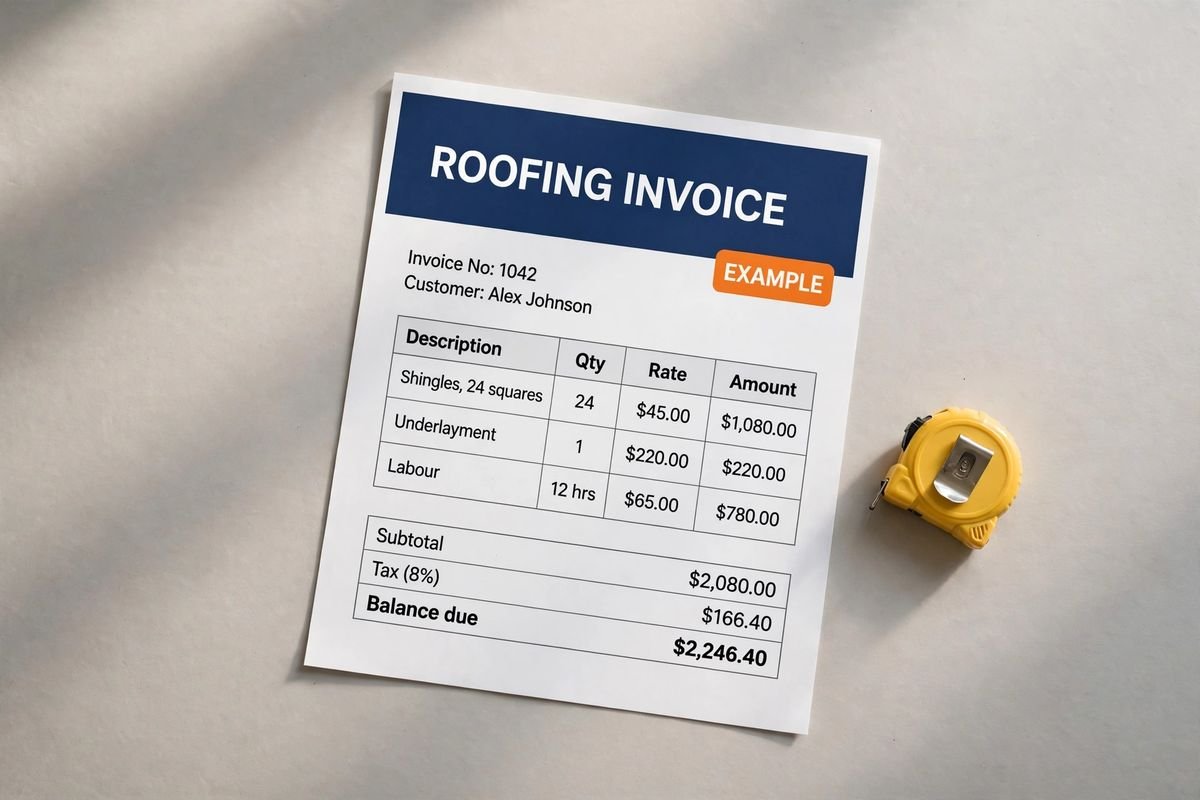
Check the balance due
Verify every formula after adding rows or changing the worksheet. A markup rate is not the same as a profit margin. Your local tax, permit and contract requirements may differ.
Ready to use it?
No signup needed. Excel 2016 or later. For Google Sheets, import the Excel file with File → Import → Upload.
Roofing invoice guide
How to invoice a roofing job and get paid on time
A roofing invoice should let the homeowner match every dollar to something they agreed to: the signed estimate, any change orders, the deposit they already paid. When the numbers line up, the invoice gets paid; when they don’t, it sits on the kitchen counter. Here is how to build one, using the same job as our roofing estimate example.
1. Start from the signed estimate
Reference the estimate number and copy its lines across rather than writing a new lump sum. If you used the estimate maker, press “Turn it into an invoice” and the lines, tax and deposit carry straight into the invoice generator — no retyping.
2. Add change orders as their own lines
Rotten decking, extra layers found during tear-off and upgraded vents are the usual changes on a roof. Bill each one as a separate change order with its number, what was done and when it was approved — never fold it into the original lines.
3. Worked example: the final invoice
During tear-off the crew found 2 sheets of rotten decking. The homeowner approved change order CO-1 on site at the $95.00-per-sheet price written on the estimate. The homeowner paid a $1,000.00 deposit when they signed.
| Invoice line | Amount |
|---|---|
| Roof replacement as estimated (EST-1001) | $10,201.00 |
| Sales tax 6% on materials | $330.00 |
| Building permit (at cost) | $150.00 |
| CO-1: replaced 2 sheets of rotten decking at $95.00 each, installed (approved on site) | $190.00 |
| Invoice total | $10,871.00 |
| Less deposit received | −$1,000.00 |
| Amount due now | $9,871.00 |
Example figures carried over from the roofing estimate example. They are not market rates.
4. Insurance jobs
On an insurance claim the homeowner may receive the payout in stages — often an initial payment, with the rest released once the insurer sees proof the work is finished. Send the invoice and completion photos promptly so the final payment is not held up, and keep any work the homeowner asked for beyond the approved claim on its own clearly priced lines.
5. Lien waivers, warranty and close-out
- Lien waivers. On larger jobs the homeowner or their lender may ask for a lien waiver before paying. A conditional waiver takes effect once payment clears; give an unconditional one only after the money is in your account. Lien notice rules and deadlines vary by state.
- Warranty paperwork. Register the manufacturer warranty if the product requires it, and hand over your workmanship warranty with the invoice.
- Final walk-through. Walk the job with the homeowner, note anything left to finish, and invoice the same day.
6. Payment terms that work for roofers
- Due on completion is normal for homeowners; commercial clients often require Net 30 — agree it before you start.
- Put a pay-online link (card or bank transfer) on the invoice; it is usually paid faster than a check.
- Follow up three days before the due date, on the due date and a week after — the invoice generator writes these reminders for you.
More roofing invoice questions
Should the invoice show the deposit?
Yes. List the full invoice total, then the deposit received with its date, then the amount due now ($9,871.00 in the example). The homeowner sees they have been credited.
How do I bill rotten decking found during tear-off?
As a change order at the per-sheet price agreed in the estimate, with the number of sheets and the date it was approved.
When should I send a roofing invoice?
The day the job is finished and walked through. Every day you wait is a day later you are paid.