Free Construction Estimate Template (Excel, Google Sheets, PDF)
Keep your construction job paperwork clear. Customize the scope, line items and business details, then share a professional estimate with your customer.
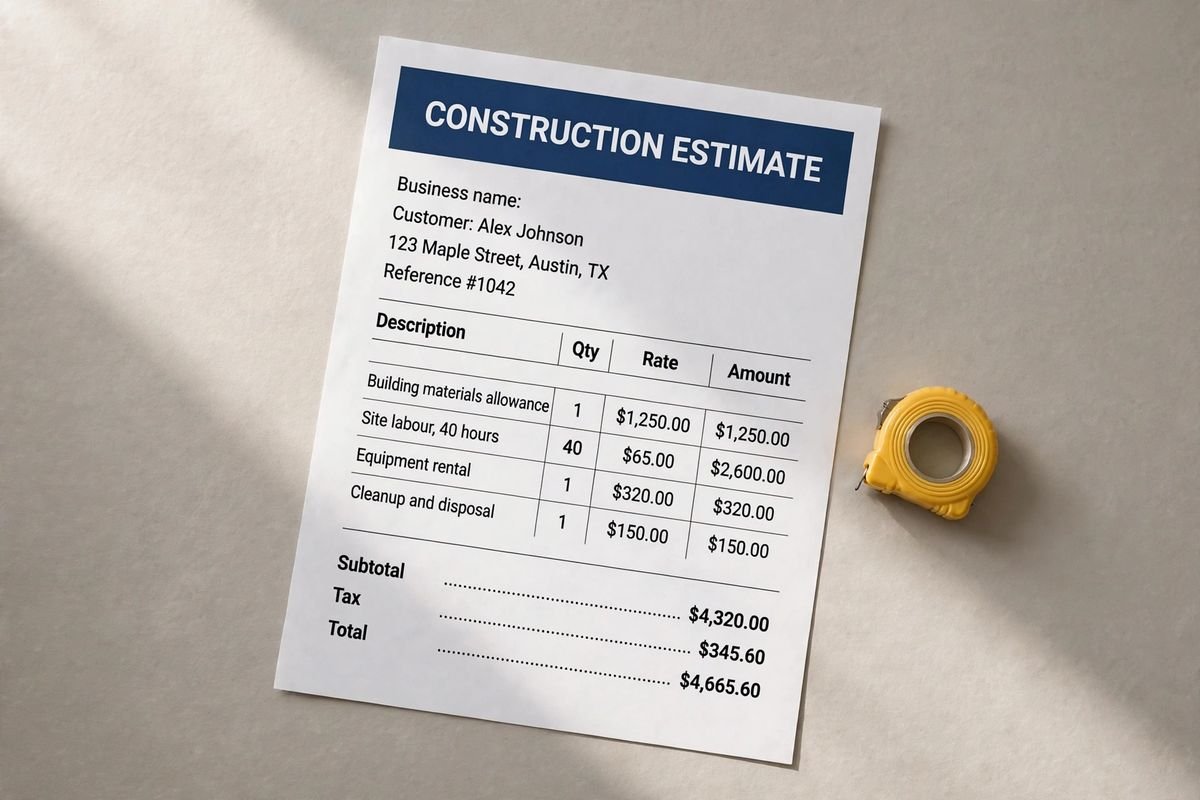
Illustrative document mockup · Construction Estimate↗ Open full size (new tab)
Download your construction estimate template
No signup needed. Excel 2016 or later. For Google Sheets, import the Excel file with File → Import → Upload.
Get the details right
What to include
Describe the work area, inclusions, allowances, schedule assumptions and exclusions. Keep scope changes separate from the original estimate.
- Your business and customer details
- Job address and document number
- Clear scope, quantities and line-item amounts
- Taxes, adjustments and total where applicable
- Payment or approval details and exclusions
Organize the scope before applying a construction total
Identify the project and the version of drawings, specifications or written scope used for pricing. Break the work into practical packages such as preparation, materials, labor, equipment and closeout. A total is easier to review when it can be traced to a defined scope. Record access, site condition and scheduling assumptions instead of implying that every unresolved project issue is included.
Label allowances for unselected items separately from confirmed quantities and supplier prices. Explain how an allowance will be reconciled when a selection is made. If progress payments are proposed, connect them to identifiable work stages or an agreed schedule of values rather than confusing billing milestones with proof that work has been completed. Retention or other deductions should be described only when they are actually part of the arrangement.
State exclusions and the process for pricing a change. Keep an estimate revision distinct from an approved change order after the job starts. Before sharing the workbook, verify units, formulas, taxes and the treatment of contingency or markup. The sample figures demonstrate arithmetic; they are not a construction cost database, contract review or recommendation for a particular project.
How to fill it in
- Define the project baseline
Enter the site, scope version and drawings or specifications used for pricing.
- Build work packages and allowances
Separate confirmed quantities from selections or costs that remain provisional.
- Check the cost calculation
Review materials, labor, equipment, adjustments and markup using project-specific figures.
- Present scope and payment assumptions
State exclusions, proposed milestones and the route for approving later changes.
A worked example
| Cost or work item | Amount |
|---|---|
| Building materials allowance | $3,200.00 |
| Site labor | $2,200.00 |
| Equipment rental | $360.00 |
| Cleanup and disposal | $240.00 |
| Direct costs | $6,000.00 |
Example only. These are not published market rates or a suggested price.
Keep the calculation clear
Verify every formula after adding rows or changing the worksheet. A markup rate is not the same as a profit margin. Your local tax, permit and contract requirements may differ.
Ready to use it?
No signup needed. Excel 2016 or later. For Google Sheets, import the Excel file with File → Import → Upload.
Construction estimate guide
How to write a construction estimate that gets approved
A construction estimate does two jobs. It tells the customer what the work costs, and it fixes the scope you will be held to. Estimates that win are the ones a homeowner or GC can check line by line: what is being built, from which drawings, with which allowances, and how the price was reached. This guide builds one complete estimate, a basement room finish, which we follow through the change order template, punch list template and contractor invoice template guides.
1. Pin the estimate to a scope and a drawing version
Start the estimate with the job address, the customer, and the exact documents you priced from, for example “Drawings A1–A3, rev. B, dated 3 Nov”. If the plans change, you can show the price was for revision B. Write the scope in one or two plain sentences (“Finish 400 sq ft of basement as one room with a closet: framing, insulation, drywall, electrical, flooring, doors, trim and paint”), then list what is not included: plumbing, HVAC changes, egress windows, moisture or mold remediation.
2. Estimate in the order the job is built
Price the work in build order: site prep and demolition, framing, mechanical and electrical rough-in, insulation, drywall, finishes, cleanup and disposal. Working in sequence makes it much harder to forget a trade, and it gives the customer a scope they can follow. Keep three kinds of cost apart: materials you buy, your own labor (hours × rate) and subcontracts (the sub's quote). They are marked up, taxed and checked differently.
3. Worked example: basement room finish
| Line item | Qty | Unit | Rate | Amount |
|---|---|---|---|---|
| Framing lumber, fasteners and adhesive | 1 | lot | $1,150.00 | $1,150.00 |
| Wall insulation, R-13 batts | 520 | sq ft | $1.10 | $572.00 |
| Drywall hang, tape and finish (subcontract) | 1,350 | sq ft | $2.40 | $3,240.00 |
| Electrical: 8 outlets, 6 recessed lights, 1 circuit (licensed subcontractor) | 1 | lot | $2,100.00 | $2,100.00 |
| Luxury vinyl plank flooring (allowance $3.25/sq ft) | 400 | sq ft | $3.25 | $1,300.00 |
| Interior doors, casing and baseboard | 1 | lot | $980.00 | $980.00 |
| Paint and primer | 1 | lot | $240.00 | $240.00 |
| Carpentry labor: framing, doors and trim | 64 | hours | $55.00 | $3,520.00 |
| Painting labor | 24 | hours | $45.00 | $1,080.00 |
| Dumpster and haul-away | 1 | each | $425.00 | $425.00 |
| Direct cost | $14,607.00 | |||
| Markup 20% on direct cost (overhead and profit) | $2,921.40 | |||
| Sales tax 6% on materials only ($4,242.00) | $254.52 | |||
| Building permit, passed through at cost | $350.00 | |||
| Estimate total | $18,132.92 |
Example prices only, to show the arithmetic. They are not market rates or a suggested price. Use your own supplier, labor and subcontractor costs, and check your state's tax and contract rules.
The markup is applied once, to the direct cost, so the customer sees one clear line for overhead and profit rather than padding hidden in every rate. Tax is charged only on materials ($4,242.00 × 6% = $254.52). In many states labor on a home improvement is not taxed, but rules differ, so check yours. The permit is passed through at cost and shown on its own line.
4. Markup is not margin
A 20% markup on cost is only a 16.7% profit margin on the selling price. Contractors who confuse the two price below their target on every job. If you want a set margin, divide cost by (1 − margin): $10,000 ÷ 0.80 = $12,500 gives a true 20% margin, which is a 25% markup.
| Markup on cost | Profit margin on the price | $10,000 of cost becomes |
|---|---|---|
| 10% | 9.1% | $11,000.00 |
| 15% | 13.0% | $11,500.00 |
| 20% | 16.7% | $12,000.00 |
| 25% | 20.0% | $12,500.00 |
| 30% | 23.1% | $13,000.00 |
5. Allowances, exclusions and contingency
When the customer has not chosen a finish, price it as an allowance and say what the allowance covers. The example uses “Luxury vinyl plank, allowance $3.25/sq ft”. If they pick a $4.50 plank, the difference becomes a change order, not an argument. Keep any contingency for hidden conditions as a separate, named line, or leave it out and state how hidden conditions will be priced. Don't bury it in your rates.
6. Payment schedule
Tie each payment to a stage the customer can see finished. Check your state's deposit rule before you set the first payment. California, for example, limits a home-improvement down payment to $1,000 or 10% of the contract price, whichever is less, which is why the deposit below is $1,000.00.
| Payment stage | Amount | Share |
|---|---|---|
| Deposit on signing | $1,000.00 | 5.5% |
| After drywall is finished | $6,853.17 | 37.8% |
| After flooring and trim are installed | $5,996.52 | 33.1% |
| Final: punch list closed and walkthrough signed | $4,283.23 | 23.6% |
| Contract total | $18,132.92 | 100% |
7. Common construction estimate mistakes
- One lump-sum line for the whole job, which gives the customer nothing to compare against a lower bid.
- Pricing materials at the exact quantity, with no waste for cuts, breakage and offcuts.
- Forgetting disposal, permits, equipment rental or the sub's mobilization charge.
- Treating markup as margin (see the table above).
- No expiry date. Material prices move, so state how long the price holds (30 days is common).
- No exclusions list, so anything not mentioned looks like it was included.
More construction estimate questions
How accurate should a construction estimate be? For a fixed-price job the estimate becomes the contract price, so it should be built from measured quantities and real supplier and sub quotes. For early budgeting, a range per square foot is fine, but label it as a budget figure, not an estimate.
What is the difference between an estimate, a quote and a bid? An estimate is your best calculation of cost and can change if the scope changes. A quote or bid is a fixed price you commit to for a defined scope. See estimate vs quote vs invoice.
Can I use this template in Google Sheets? Yes. Download the Excel file and import it with File → Import → Upload. The formulas carry over; check them once before your first job.
Want the whole set of matching forms? The Construction Paperwork Pack has this estimate as a workbook with a price book and job costing, plus the matching change order, daily log, punch list and invoice. Or make one now in the free online estimate maker.